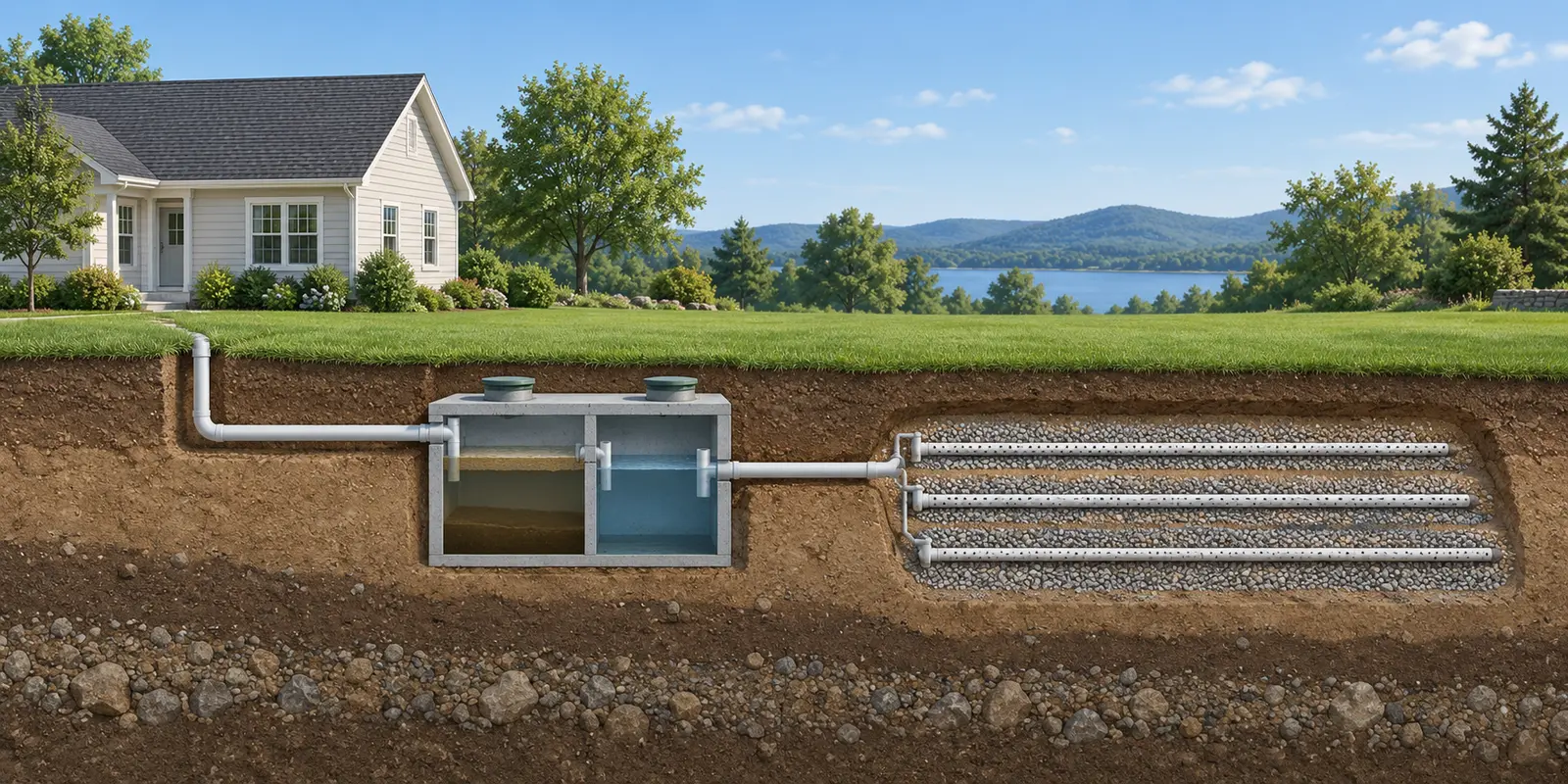
A conventional septic system treats household wastewater on the property instead of sending it to a municipal sewer. Wastewater flows from the home into a buried septic tank, where solids and grease separate from the liquid. The liquid then moves to a drainfield, where unsaturated soil provides additional treatment before the water continues through the ground. The tank and drainfield work as one system, so protecting both is essential.
This guide explains each stage in plain language, shows what the main components do, and identifies the homeowner habits that help the system keep working. It describes a typical gravity-fed system; pumps, aerobic treatment units, mound systems, and other designs may operate differently.
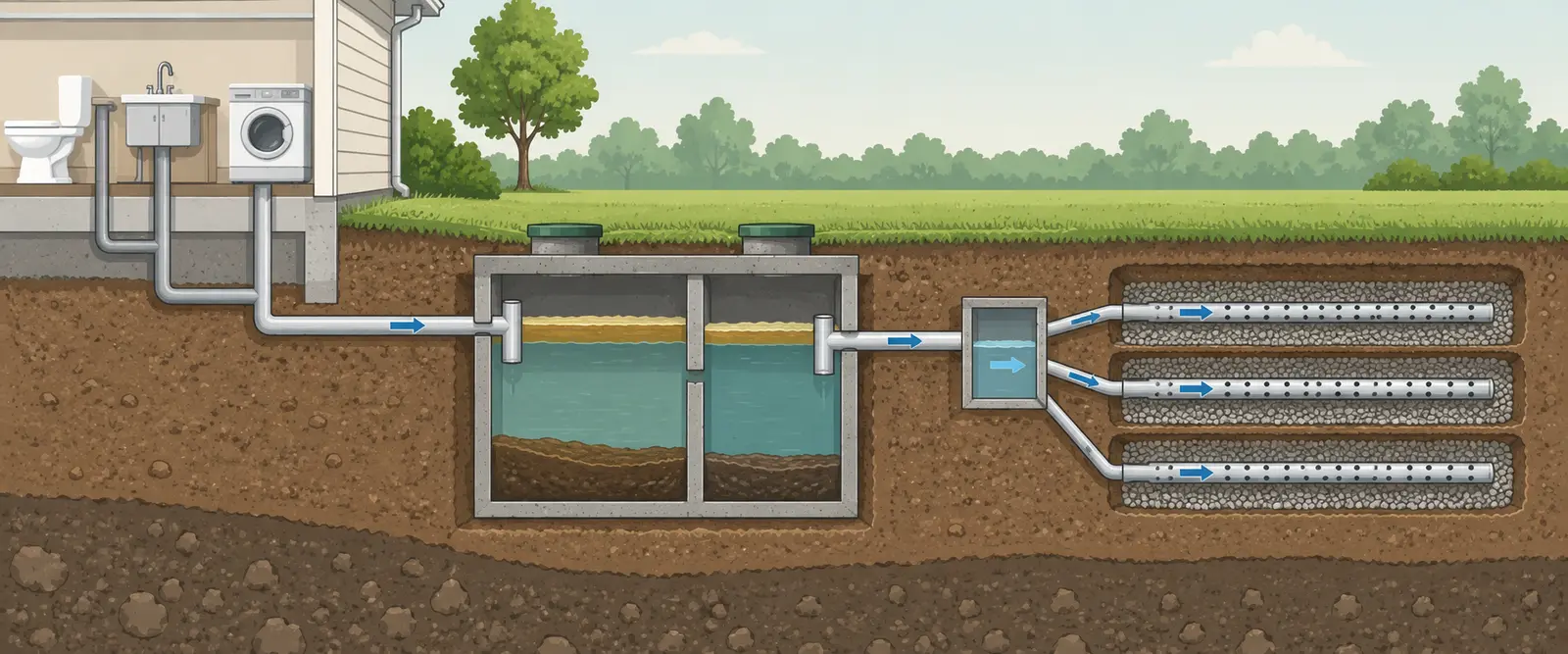
The five-step journey from drain to soil
The exact layout varies by property, but the basic process in a conventional system is straightforward.
- Wastewater leaves the home. Water from toilets, sinks, showers, tubs, dishwashers, and washing machines enters one main building sewer.
- The septic tank slows the flow. The buried, watertight tank holds wastewater long enough for heavier solids to settle and lighter material to rise.
- Liquid exits the tank. Effluent passes through the outlet, often through an effluent filter, while baffles or tees help keep floating scum and settled sludge inside.
- The distribution system spreads the flow. Depending on the design, gravity, a distribution box, or a pump sends effluent into perforated drainfield pipes or chambers.
- The soil treats and disperses the effluent. Wastewater moves through unsaturated soil, where physical filtration and microbial activity reduce contaminants before the water reaches groundwater.
The U.S. Environmental Protection Agency describes the same sequence: one household drain leads to the tank, liquid leaves for the drainfield, and the soil accepts, treats, and disperses the wastewater.
What happens inside the septic tank?
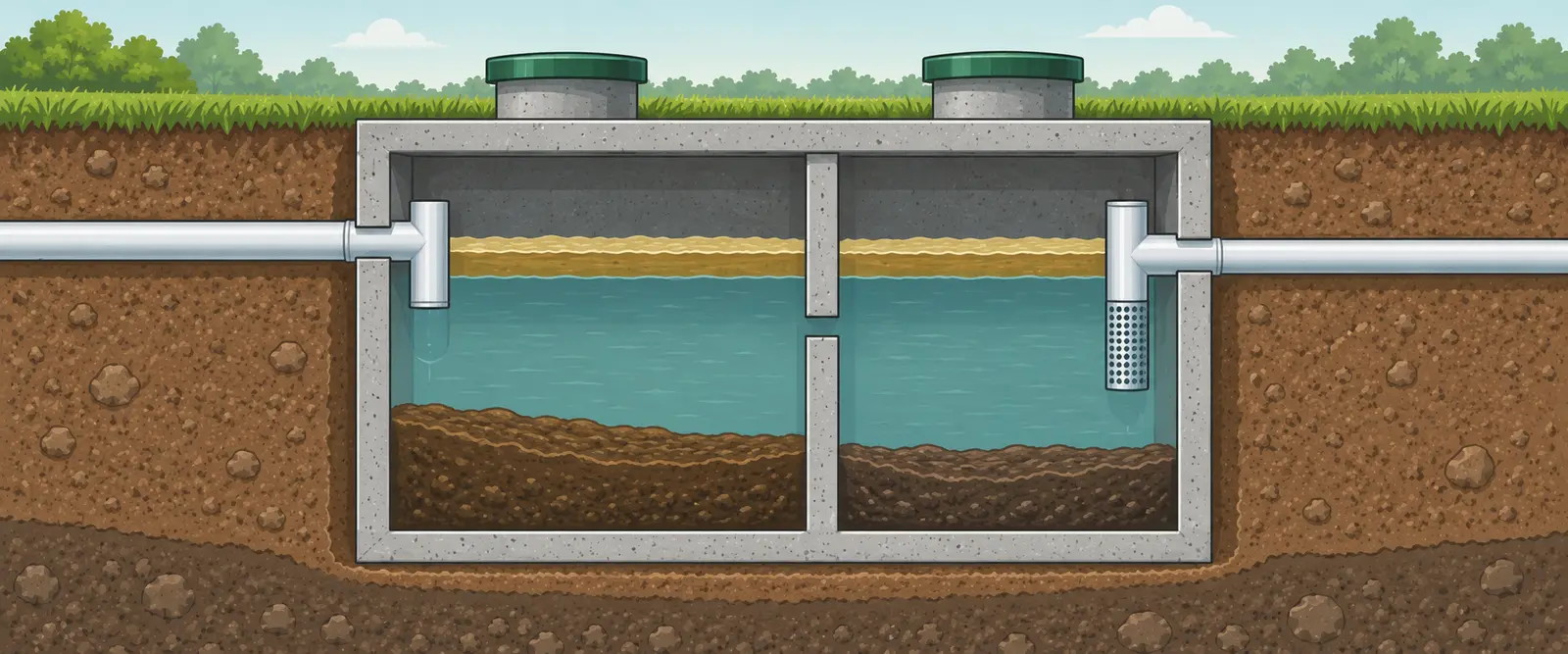
The tank is the first treatment stage, not the final destination. Its main job is to separate wastewater into layers and keep most solids out of the drainfield.
Scum rises
Fats, oils, grease, and other buoyant material collect near the surface. This upper layer is called scum. An inlet or outlet tee helps prevent this material from flowing straight through the tank.
Sludge settles
Dense solids sink to the bottom and form sludge. Microorganisms break down some organic material, but digestion is incomplete. The remaining sludge accumulates and eventually has to be pumped out.
Effluent stays in the middle
Between the scum and sludge is a liquid layer called effluent. This is the portion that leaves the tank for further treatment. It is not clean drinking water and can still contain pathogens, nutrients, and suspended material.
| Tank zone | What it contains | Why it matters |
|---|---|---|
| Scum layer | Floating fats, oils, grease, and light solids | Must remain below the outlet opening |
| Liquid layer | Partially treated effluent | Moves to the drainfield for soil treatment |
| Sludge layer | Settled solids and partially digested material | Builds up over time and requires pumping |
A tank can look “full” of liquid even when it is operating normally because the working liquid level is usually close to the outlet elevation. Pumping decisions are based on sludge and scum accumulation, system condition, tank size, household use, and inspection findings, not on the presence of liquid alone.
What the inlet, outlet, baffles, and filter do
Small components inside and around the tank have an outsized role in protecting the drainfield.
- Inlet pipe: carries wastewater from the house into the tank.
- Inlet tee or baffle: directs incoming flow downward and limits disturbance of the scum layer.
- Outlet tee or baffle: draws liquid from the clearer middle zone instead of the scum at the surface.
- Effluent filter: captures additional suspended solids before they can enter the drainfield. Not every older system has one.
- Access lids and risers: provide service access for inspection, filter cleaning, and pumping.
These parts should be inspected by a qualified professional. A septic tank is a confined space that may contain toxic gases and has a serious fall risk. Never enter a tank, lean over an unsecured opening, or leave a lid unsecured.
How the drainfield finishes the treatment process
The drainfield receives effluent in controlled amounts and distributes it across an area of suitable soil. In a traditional gravel system, perforated pipes sit in shallow trenches. Chamber systems use open-bottom structures instead of gravel around the distribution pipe. Other systems may use pumps, pressure distribution, sand, or raised mounds.
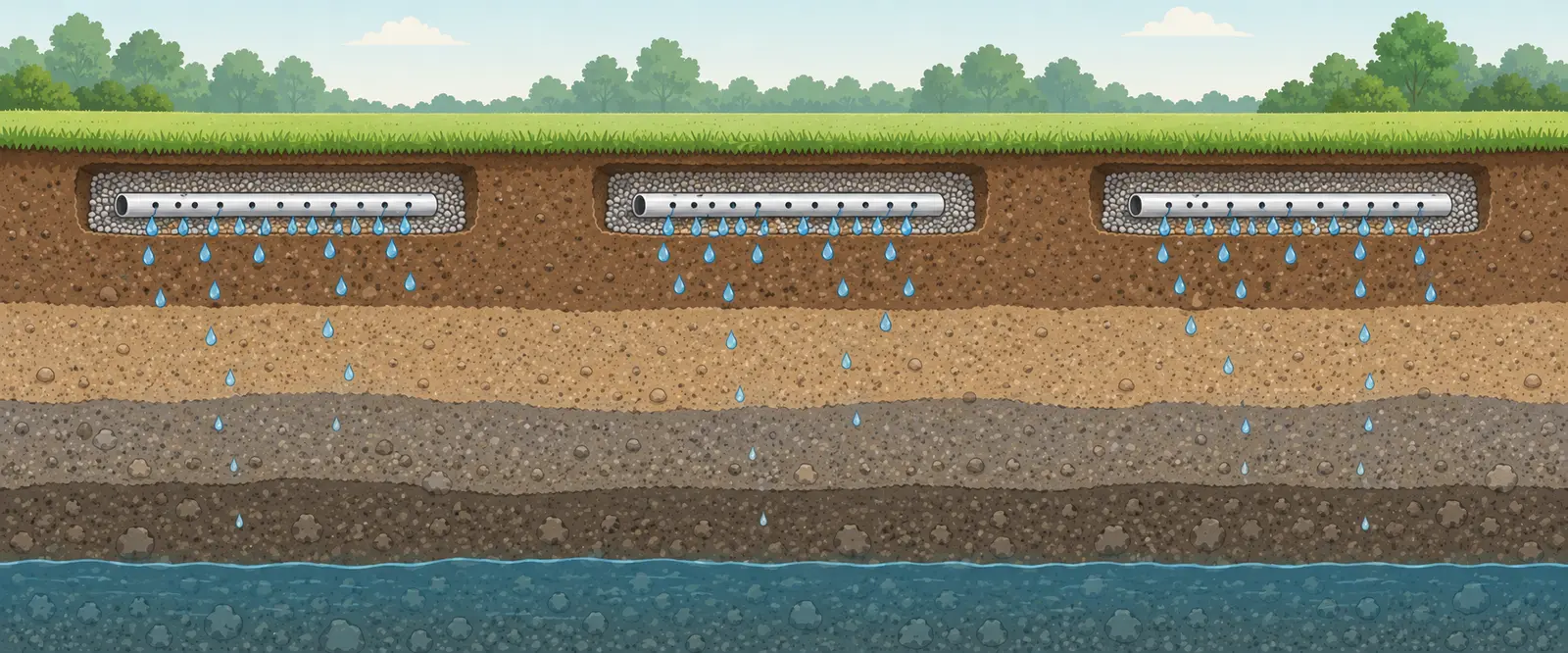
As effluent leaves the pipe or chamber, it moves across a porous surface and into unsaturated soil. The soil provides three important functions:
- Filtration: soil particles physically retain some suspended material.
- Biological treatment: microorganisms transform or reduce organic matter and certain contaminants.
- Dispersal: treated water moves outward and downward rather than collecting at the surface.
The EPA notes that conventional systems rely on unsaturated soil. When the drainfield is overloaded, compacted, or saturated by rainwater or groundwater, it may not accept effluent at the required rate. That can contribute to slow drains, plumbing backups, sewage odors, or wastewater surfacing outside.
The component map: where each problem begins
| Component | Normal role | If performance is reduced |
|---|---|---|
| Building sewer | Moves wastewater from the home to the tank | A blockage may affect several fixtures before wastewater reaches the tank |
| Septic tank | Separates solids, scum, and liquid | Excess solids may move toward the outlet |
| Effluent filter | Limits solids leaving the tank | A clogged filter may slow flow or contribute to a backup |
| Distribution box or pump | Sends effluent across the drainfield | Uneven or interrupted distribution can overload part of the field |
| Drainfield | Distributes effluent into suitable soil | Saturation or damage can cause surfacing wastewater or indoor backups |
| Unsaturated soil | Filters and biologically treats effluent | Poor site conditions can reduce treatment and dispersal |
This map helps explain why the same symptom can have different causes. A slow drain could result from a local plumbing clog, a restricted building sewer, a filter issue, hydraulic overload, or a drainfield problem. The symptom alone does not identify the failed component.
Gravity systems versus systems with pumps
Some systems move effluent entirely by gravity. Others need a pump because of site elevation, soil conditions, or the treatment design.
A pumped system may include a separate pump chamber, floats, an alarm, and electrical controls. The alarm usually indicates a high liquid level or another condition that needs attention; it does not automatically reveal the exact cause. Reduce water use and contact a septic professional if the alarm remains active. Do not open electrical controls or enter a tank.
Aerobic treatment units add oxygen to encourage different biological processes. Mound systems use a constructed sand mound where native soil or groundwater conditions are unsuitable for a conventional field. The EPA’s overview of common septic system types shows why a homeowner should identify the actual design before applying general maintenance advice.
What a septic system does not do
Understanding the limits of the system prevents several common mistakes.
- It does not make every substance safe to pour down a drain.
- It does not eliminate the need to remove accumulated solids.
- It does not have unlimited capacity for simultaneous showers, laundry, and leaking fixtures.
- It does not protect itself from vehicles, buildings, pavement, aggressive roots, or diverted stormwater.
- It does not operate identically on every property.
Products marketed as septic additives are not a substitute for inspection, pumping, or repair. A properly functioning tank already contains microorganisms associated with household wastewater. Local requirements and system-specific service instructions take priority over broad product claims.
How everyday water use affects treatment
Every gallon used indoors eventually reaches the septic system. A large surge can shorten the settling time inside the tank and send more flow to the drainfield than the soil can accept at once.
Practical ways to reduce unnecessary loading include repairing running toilets, choosing the correct laundry load size, spreading laundry across the week, and using water-efficient fixtures. The EPA recommends efficient water use because it supports system operation and reduces malfunction risk. Its current homeowner guidance also advises keeping roof drains, sump pumps, and other rainwater drainage away from the drainfield.
Homeowner actions that protect the system

- Know where the tank, access lids, and drainfield are located.
- Keep installation, permit, inspection, and pumping records.
- Have the system inspected on the schedule required for its type and local rules.
- Pump based on professional measurements and household conditions rather than waiting for a backup.
- Flush only human waste and toilet paper.
- Keep grease, wipes, paint, fuel, pesticides, medications, and other harmful materials out of drains.
- Do not drive, park, pave, or build over the drainfield.
- Keep excess surface water away from the treatment area.
- Use a septic professional for tank access, diagnosis, service, and repair.
For a growing collection of homeowner explanations and maintenance resources, visit the SepticBeacon Guides page. You can also review how SepticBeacon develops its practical guidance.
How often should the tank be inspected or pumped?
There is no single interval that fits every household. The EPA says an average household system should generally be inspected at least every three years and that tanks are typically pumped every three to five years. Systems with pumps, floats, or mechanical components often need more frequent inspection, commonly once a year.
Those figures are national guidance, not a replacement for local rules or measurements. Household size, wastewater volume, tank capacity, solids loading, garbage disposal use, and the system type all affect the service interval. A professional can measure sludge and scum, inspect the tank and baffles, and record conditions for the next service decision. See the EPA’s septic care guidance for its maintenance recommendations.
Warning signs that need prompt attention
Contact a qualified septic professional if you notice sewage backing up into fixtures, persistent gurgling across multiple drains, wastewater or unusually soggy ground near the tank or drainfield, strong sewage odors, a septic alarm, or unusually bright green growth over part of the field. Reduce water use while arranging service.
Keep people and pets away from surfacing wastewater. Do not open the tank to investigate and do not attempt to enter it. If sewage is backing up into the home, avoid contact, protect the affected area, and obtain professional help.
Frequently asked questions
Does all household water go into the septic tank?
In a typical residential setup, wastewater from connected indoor fixtures flows to the septic tank. Roof drains, foundation drains, sump pumps, and other stormwater sources should not discharge into the septic system.
Does the septic tank clean the wastewater completely?
No. The tank performs separation and partial treatment. The drainfield and unsaturated soil provide additional treatment and dispersal. Effluent leaving the tank can still contain contaminants.
Why does the septic tank need pumping if bacteria break down waste?
Microorganisms do not digest all solids. Sludge and scum accumulate over time. Pumping removes that material before it reduces working volume or reaches the outlet and threatens the drainfield.
Can I inspect the inside of my own septic tank?
Homeowners can keep records and observe conditions around the property, but tank access and internal inspection should be handled by a qualified professional. Septic tanks present toxic-gas, fall, and confined-space hazards.
Are all septic systems built the same way?
No. Soil, lot size, slope, groundwater, household size, local regulations, and treatment requirements influence the design. Conventional gravity systems, chamber systems, pressure distribution, aerobic units, sand filters, and mound systems differ in both components and maintenance needs.
The bottom line
A septic system works through a sequence: the household pipe collects wastewater, the tank separates solids and scum, the outlet delivers effluent, the distribution system spreads it, and the soil provides final treatment and dispersal. The drainfield is not an overflow area; it is an active treatment component. Sensible water use, proper waste disposal, professional inspection, timely pumping, and protection of the drainfield help every stage do its job.
This article provides general educational information for U.S. homeowners. Septic requirements vary by state, county, site, and system design. Follow your permit, manufacturer instructions, local health authority requirements, and the advice of a qualified septic professional.